Listen to “Google Launches Its Official AI Detector: SynthID Detector”
Prefer listening? Get the key insights from this guide in just a few minutes.
AI Smart Summary
- SynthID Detector is Google’s tool for identifying AI-generated content through invisible watermarks.
- The SynthID Detector can verify watermarks in images, video, and audio, while SynthID technology also supports AI-generated text.
- It doesn’t detect all AI content—it primarily identifies content created by supported AI systems that use SynthID.
- The watermark is designed to survive common edits like cropping, compression, resizing, and filtering.
- A positive result indicates the presence of a SynthID watermark, but no watermark does not necessarily mean the content is human-made.
- Bottom line: SynthID is a watermark/provenance system, not a universal AI detector.
AI Detailed Summary
Artificial intelligence has made it easier than ever to create realistic images, videos, and audio. But as AI-generated content becomes more convincing, identifying what is real and what is artificially created is becoming increasingly difficult.
To address this challenge, Google has expanded access to its SynthID Detector, an AI detection tool designed to help people identify AI-generated media through invisible digital watermarks.
On October 7, 2026, Google announced that SynthID Detector would become available globally in English, allowing more users to verify supported AI-generated content.
What Is Google’s SynthID Detector?
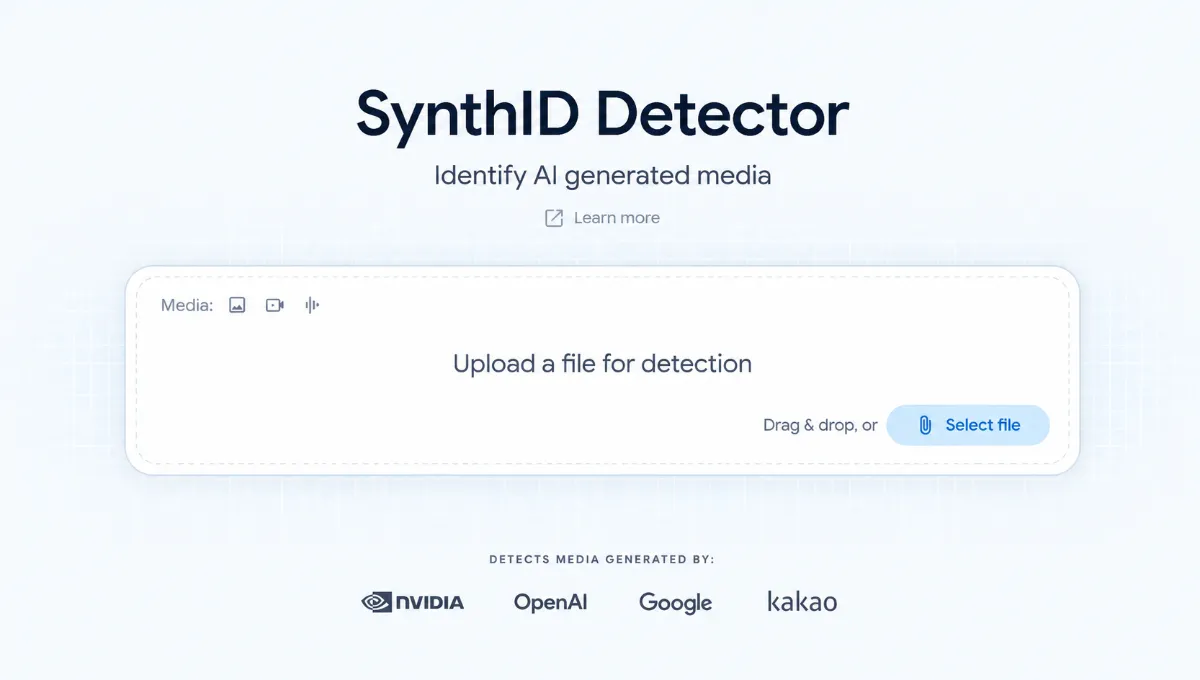
SynthID Detector is an AI checker developed by Google DeepMind to identify digital content containing SynthID watermarks.
Unlike a traditional AI detector that analyzes patterns to predict whether content was created by artificial intelligence, SynthID Detector looks for embedded signals added during the AI generation process.
These watermarks are designed to remain invisible to viewers without noticeably changing the quality of the content.
The tool supports verification of eligible AI-generated images, videos, and audio, including content from participating technology providers.
How Does SynthID Detector Work?
Google’s AI image detection tool uses digital watermarking technology rather than relying solely on visual clues or statistical predictions.
Here’s how the process works:
- Upload your content: Select an image, video, or audio file for verification.
- Watermark analysis: The tool scans the uploaded media for recognizable SynthID signals.
- Detection results: It reports whether supported AI watermark evidence was found.
- Review the findings: Users can better understand whether the content may have originated from a participating AI system.
However, an unsuccessful watermark check does not automatically mean the content is human-made. AI-generated files without compatible watermarks may go undetected.
Key Features of Google’s New AI Detector
Google’s SynthID Detector introduces several useful capabilities for people working with digital content.
Here’s a breakdown of what SynthID technology can detect:
| Content Type | How SynthID Works | What It Can Detect |
| AI-Generated Images | Identifies invisible watermarks embedded in image pixels. | Images created or modified using compatible AI tools. |
| AI-Generated Videos | Checks video frames for embedded digital watermarks. | Watermarked AI-generated or AI-edited video content. |
| AI-Generated Audio | Detects inaudible watermark signals within audio. | Audio produced using supported AI models. |
| AI-Generated Text | Uses statistical watermarking patterns in generated text. | Text generated by compatible SynthID-enabled language models. |
| AI-Generated Biological Designs | Uses specialized SynthID Bio watermarking techniques. | Certain AI-generated biological sequences, such as protein designs. |
Important: SynthID technology has different capabilities across content types. The publicly expanded SynthID Detector announced in October 2026 focuses on checking supported images, videos, and audio. Text watermarking and SynthID Bio are separate capabilities and should not be presented as publicly available detection options in that tool.
Also, SynthID cannot detect every AI-generated file. If content was created without a compatible watermark, the detector may not identify it.
This makes SynthID a useful verification tool, but not a replacement for broader content authenticity checks.
Is SynthID Detector Different From ChatGPT Detector and Turnitin?
Yes. Although these tools are associated with AI detection, they serve different purposes.
A ChatGPT detector, ChatGPT checker, or Turnitin AI checker typically evaluates written content to estimate whether it may have been AI-generated.
Google’s SynthID Detector instead focuses on detecting compatible digital watermarks in supported media.
Similarly, an artificial intelligence checker may use language patterns or other indicators to perform an AI check, whereas SynthID looks for specific watermark evidence.
This distinction matters because no single tool can reliably identify every form of AI-generated content.
Can SynthID Detector Identify Humanized AI Content?
Many writers use an AI humanizer, humanizer AI, or other tools to humanize AI text and make machine-generated writing sound more natural.
SynthID Detector is not a general-purpose text humanization checker. Its newly expanded public verification capabilities focus on supported watermarked media.
Users looking for an AI detector free, AI checker free, or tools that AI detect written content should understand that text detection and digital watermark verification are different technologies.
Why Does Google’s SynthID Detector Matter?
AI-generated media is increasingly used in advertising, social media, entertainment, and digital communication.
While these technologies create exciting opportunities, they also raise concerns about misleading visuals, impersonation, and manipulated information.
SynthID Detector offers an additional way to investigate the origins of digital content. It can help creators demonstrate transparency and give audiences more context before trusting or sharing media.
For digital marketers, the development also highlights the growing importance of responsible AI use and clear content disclosure.
Want to read from a genuine source?
CLICK HERE: Google expands SynthID Detector for AI content
Bottom of The Line
Google’s SynthID Detector represents an important development in AI content verification. By expanding access to watermark detection, Google is making it easier for users to investigate whether supported images, videos, and audio were generated using AI.
However, the tool is not a universal AI checker. Its effectiveness depends on whether the content contains recognizable SynthID watermarks.
As artificial intelligence continues to evolve, tools like SynthID Detector could play an increasingly important role in building trust and transparency across the digital world.