AI Fast Fact
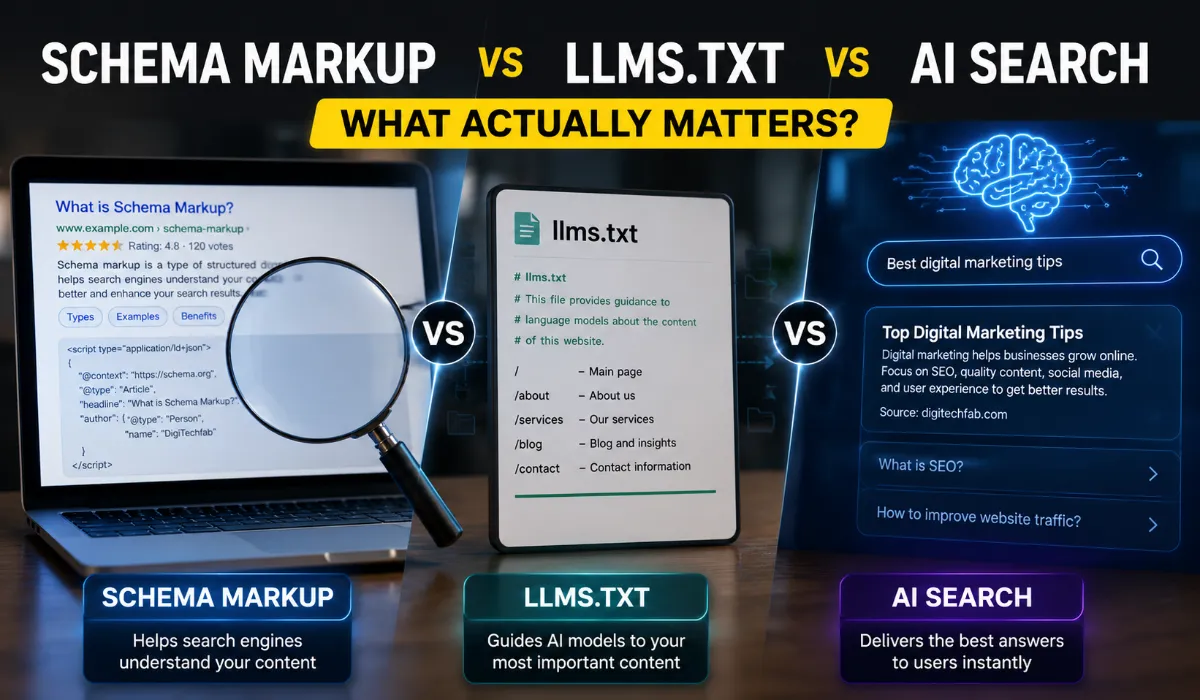
Schema Markup, llms.txt, and AI Search help websites in different ways. Schema.org structured data helps search engines understand important details on a webpage, such as product information, articles, business details, and reviews. llms.txt is a proposed file that gives language models a simple guide to understand the key content of a website. AI Search refers to modern search platforms that provide direct answers by collecting and understanding information from different online sources, including tools like ChatGPT, Perplexity, and Google’s AI Overviews.
Intro
Many businesses are unsure where to invest their SEO efforts. Should they focus on schema markup, create an LLMs.txt file, or prepare for AI Search? While all three topics are connected to how websites are understood online, they solve different problems. This comparison explains what each one does, how important it is, and what businesses should prioritize for better search visibility.
| Comparison Factor | Schema Markup | LLMs.txt | AI Search Optimization |
|---|---|---|---|
| Basic Definition | Schema markup is code added to webpages to help search engines understand content details using structured data. | LLMs.txt is a file format designed to provide AI systems with important website information in a clearer format. | AI Search optimization focuses on improving website visibility in AI-generated answers and generative search experiences. |
| Main Purpose | Helps search engines identify content types like products, articles, reviews, and businesses. | Helps guide large language models and AI tools toward useful website information. | Helps websites become more understandable, trustworthy, and relevant for AI-driven search platforms. |
| Created For | Mainly created for search engines and supported through Schema.org standards. | Created for AI systems and tools that process website information. | Created around modern search behavior where users receive AI-generated responses. |
| How It Works | Adds specific markup to webpages so search engines can interpret information accurately. | Provides structured instructions or content references for AI systems. | Uses content quality, authority, website structure, and technical improvements to improve AI understanding. |
| Primary Users | Search engines, website owners, developers, and SEO professionals. | AI platforms, website owners, and developers testing AI accessibility. | Search engines, AI platforms, marketers, and SEO teams. |
| Helps Search Engines Understand | Yes. It improves how search engines identify page elements and topics. | Limited impact because adoption is still developing. | Yes, through better content organization and website signals. |
| Helps AI Systems Understand | Can support AI understanding because structured information provides clear context. | Specifically designed for AI systems and AI crawlers. | Focuses on overall website understanding by AI systems. |
| Impact on Traditional SEO | Strong support for enhanced listings and better content interpretation. | Minimal direct SEO impact at present. | Supports future-focused SEO strategies. |
| Impact on AI Search Visibility | Helps provide clearer information but is only one ranking signal. | May support AI content discovery but does not guarantee visibility. | Plays a major role in improving AI visibility. |
| Ranking Impact | Does not directly guarantee rankings but can improve eligibility for rich results. | No confirmed direct ranking benefit. | Depends on content quality, authority, and relevance. |
| Content Understanding | Provides clear signals about page meaning and information relationships. | Provides additional information that AI tools may use. | Requires detailed, accurate, and user-focused content. |
| Technical Requirement | Requires adding markup code or using SEO plugins. | Requires creating and maintaining an LLMs.txt file. | Requires technical SEO, content improvements, and ongoing optimization. |
| Implementation Process | Add relevant schema types such as Product, FAQ, Article, or Local Business markup. | Create a file containing useful website information for AI systems. | Improve content structure, expertise signals, internal linking, and website performance. |
| Difficulty Level | Medium. Basic implementation is simple with plugins. | Low to medium depending on website size. | Medium to high because it involves multiple SEO areas. |
| Maintenance Requirement | Update when website information changes. | Needs updates when important website content changes. | Requires continuous content and SEO improvements. |
| Adoption Level | Widely used and supported across search platforms. | Still limited and experimental. | Rapidly becoming an important SEO focus. |
| Current SEO Importance | High value for technical SEO and search understanding. | Useful for testing but not a priority for most websites. | High importance for businesses preparing for future search behavior. |
| Future Importance | Expected to remain valuable as search systems need better data understanding. | May become more useful as AI adoption grows. | Expected to become a key part of online visibility strategies. |
| Best Use Cases | Product pages, blogs, FAQs, local businesses, reviews, and events. | Websites wanting to experiment with AI-friendly content access. | Businesses wanting visibility across AI-powered search experiences. |
| Example Implementation | Adding FAQ Schema to a service page or Product Schema to an ecommerce page. | Adding important website resources and content details in LLMs.txt. | Creating expert content that answers customer questions clearly. |
| Common Mistakes | Adding incorrect markup or using irrelevant schema types. | Assuming LLMs.txt alone will improve rankings or traffic. | Focusing only on keywords while ignoring user intent and authority. |
| Limitations | Does not replace quality content or guarantee higher rankings. | Limited adoption and unclear impact across AI platforms. | Requires ongoing effort across content, technology, and authority building. |
| Recommended For | All websites that want better search understanding. | Businesses interested in preparing for AI experiments. | Businesses targeting long-term organic and AI visibility. |
| Should Businesses Prioritize It? | Yes, implement relevant schema markup where possible. | Test it, but do not depend on it as the main strategy. | Yes, combine it with strong SEO practices. |
| Final Verdict | A proven SEO technique that improves search understanding. | A supporting technology that may become more important later. | The broader strategy businesses need for modern search success. |
What Actually Matters?
Schema markup helps search engines understand your website, while LLMs.txt is an emerging method that may support AI systems. However, long-term success with AI Search depends on valuable content, strong authority, user experience, and proper technical SEO. Businesses should focus on building a strong SEO foundation first, then adopt new technologies where they provide real value.
Now It’s Time for FAQs
Is LLMs.txt important for SEO?
LLMs.txt is still an emerging concept and is not a confirmed Google ranking factor. It may help some AI tools understand website content, but businesses should focus more on quality content, technical SEO, and structured data.
Is schema markup still relevant?
Yes, schema markup is still relevant. It helps search engines understand webpage information and can improve how content appears in search results through enhanced features like rich results.
Does schema matter for SEO?
Yes, schema matters for SEO because it gives search engines extra context about your content. It supports better content understanding but does not directly guarantee higher rankings.
Is FAQ schema still relevant?
Yes, FAQ schema is still useful for helping search engines understand question-based content. However, FAQ rich results are now shown less frequently, so it should be used mainly when FAQs genuinely help users.
Is ChatGPT LLM or NLP?
ChatGPT is an LLM (Large Language Model) that uses NLP (Natural Language Processing) techniques. NLP is the broader field, while LLM is the technology model behind ChatGPT.
Why is ChatGPT called GPT?
GPT stands for Generative Pre-trained Transformer. It means the model can generate text, is trained on large datasets before use, and uses the Transformer architecture to understand language patterns.
How many types of schema markup are there in SEO?
There are hundreds of schema types available through Schema.org. Common SEO types include Article, Product, FAQ, Review, Local Business, Organization, Event, Recipe, and Video Schema.
Is LLMs.txt important for SEO?
Currently, LLMs.txt is not a must-have SEO element. It can be tested as an additional step, but strong content, technical SEO, and website authority remain more important.
What is an AI Search called?
AI Search is commonly called AI-powered search, generative search, or answer engines. These systems provide direct answers by understanding information from multiple sources.
What are the top 3 most used AI?
Some of the most widely used AI tools are:
- ChatGPT – AI assistant for writing, research, coding, and problem-solving.
- Google Gemini – AI assistant integrated with Google services.
- Microsoft Copilot – AI assistant used across Microsoft products and workflows.