AI Feature Summary – OKF Prospective
OKF stands for Open Knowledge Format. It is a simple, open way to organize and describe knowledge, including important details, context, and connections between different information sources. OKF uses Markdown files with YAML frontmatter to keep knowledge structured and easy to understand. Its main purpose is to help people and AI agents access, share, and use information more effectively across different systems.
AI Feature Summary – SEO Prospective
- OKF is not a confirmed Google ranking factor.
- Implementing OKF alone will not increase organic traffic.
- OKF does not automatically improve website indexing or crawling.
- OKF does not guarantee visibility in Google AI Overviews or AI search results.
- OKF is not a shortcut for achieving better SERP positions.
- OKF cannot fix poor content quality or weak website authority.
- OKF does not replace Schema Markup, JSON-LD, or other SEO structured data methods.
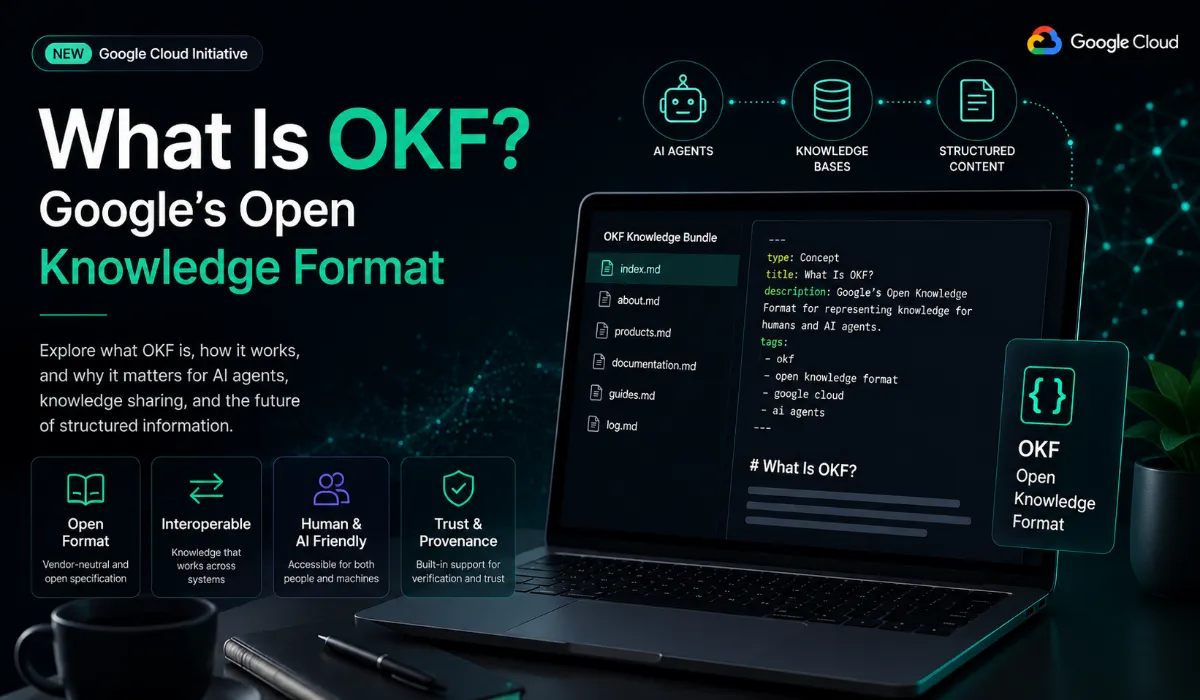
Artificial intelligence systems are becoming more useful, but they depend heavily on having the right information and context. An AI agent can process large amounts of data, but without proper structure and meaning, it may struggle to understand how different pieces of information connect.
Modern organizations store knowledge across many places, including databases, documentation, analytics platforms, and internal systems. This creates a challenge: how can businesses organize knowledge in a way that is understandable for both people and AI systems?
To address this challenge, Google Cloud introduced Open Knowledge Format (OKF) as an open, vendor-neutral approach for representing knowledge, metadata, context, and curated information. The goal of OKF is to make knowledge easier to organize, share, and move between different systems.
The Google Open Knowledge Format is not a search algorithm or an SEO ranking system. Instead, it focuses on knowledge representation and interoperability, helping humans and AI agents work with structured information more effectively.
What Is Open Knowledge Format (OKF)?
Open Knowledge Format (OKF) is an open format designed to describe and organize knowledge in a structured but human-readable way.
In simple terms, OKF provides a common method for creating knowledge documents that explain concepts, relationships, and important details about information assets.
For example, a company may have information about:
- Business metrics
- Data tables
- APIs
- Software systems
- Internal processes
- Technical resources
Instead of keeping this information scattered across different platforms, an OKF format allows organizations to represent this knowledge in a consistent structure.
OKF is designed to be:
- Open — available for different tools and users
- Vendor-neutral — not limited to one software platform
- Portable — knowledge can be moved between systems
- Interoperable — different applications can work with the same knowledge format
The main purpose of OKF is not to replace existing technologies but to create a simple way to represent knowledge that can be understood by both humans and machines.
How Does OKF Work?
The structure of Open Knowledge Format is based on familiar technologies: Markdown files and YAML frontmatter.
Each knowledge concept is stored as a Markdown file. Markdown is a lightweight formatting language commonly used for documentation because it is easy for people to read and edit.
At the beginning of an OKF Markdown file, YAML frontmatter provides structured information about that knowledge item.
For example, a document describing a business metric may contain metadata such as:
- Name of the metric
- Description
- Type of information
- Related concepts
- Additional attributes
The YAML frontmatter acts like a label that helps systems understand what the document represents.
The main Markdown section then provides detailed explanations in normal text.
This combination creates a balance:
- Machines can read structured metadata
- Humans can understand the written explanation
An OKF collection is known as an OKF bundle. A bundle is a group of related knowledge files organized together. Each file represents an individual knowledge concept, and links can connect related concepts.
For example, a knowledge bundle may contain:
- A document about a database table
- A document explaining a business term
- A document describing an API
- Links showing relationships between these concepts
Navigation files can help users and systems discover different parts of the knowledge collection.
Why Did Google Cloud Introduce OKF?
The growth of AI systems has increased the need for reliable and organized information. AI agents often need more than simple text. They need context about what information means and how different resources are connected.
For example, an AI agent working with company data may need to understand:
- What a specific dataset represents
- How a business measurement is calculated
- Which systems depend on each other
- Where certain information comes from
Without clear context, AI systems may have difficulty using organizational knowledge correctly.
Google Cloud introduced OKF as a way to represent this type of information in a structured format. By creating portable knowledge files, organizations can make important information easier to discover and reuse across different tools and environments.
This approach is especially relevant for teams managing large AI knowledge bases, technical documentation, and internal knowledge systems.
Is OKF an SEO Ranking Factor?
No. OKF is not a confirmed Google Search ranking factor.
There is currently no official indication that creating OKF files will directly improve website rankings, increase organic traffic, or provide guaranteed visibility in Google AI Overviews or other AI platforms.
The connection between OKF and SEO should be understood carefully.
SEO focuses on helping search engines understand and evaluate web content through practices such as useful content creation, technical optimization, structured data, and website quality improvements.
OKF has a different purpose. It is primarily a knowledge representation and portability format.
While structured and accessible knowledge can be valuable in AI-driven environments, businesses should not treat OKF as an SEO shortcut or a replacement for established SEO practices.
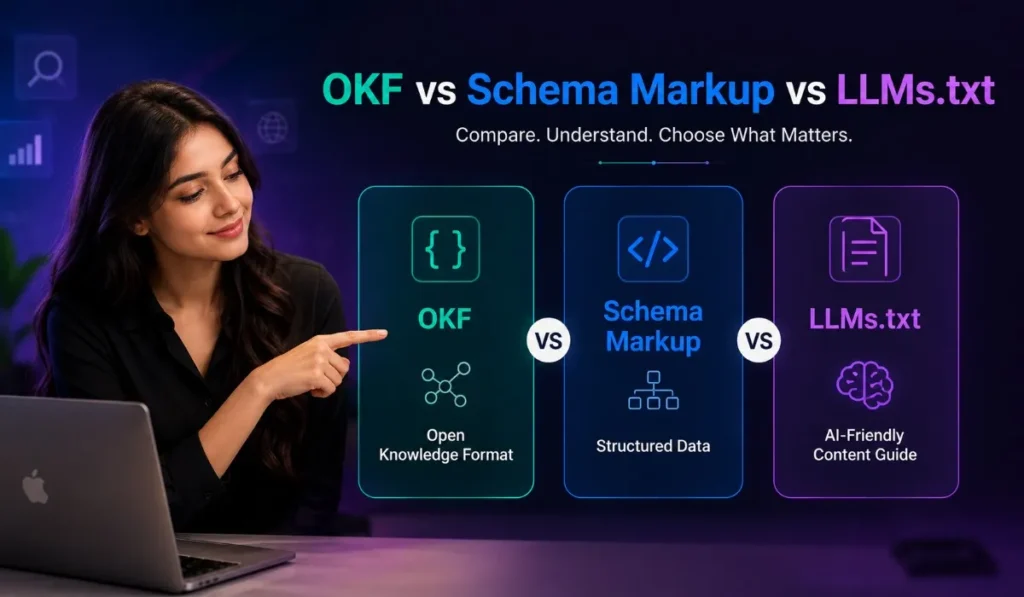
OKF vs Schema Markup vs LLMs.txt: What’s the Difference?
| Feature | Open Knowledge Format (OKF) | Schema Markup | LLMs.txt |
|---|---|---|---|
| Main Purpose | Represents and organizes broader knowledge, metadata, context, and relationships for humans and AI agents | Helps search engines understand specific information on web pages | Provides guidance about website content and resources for AI systems |
| Primary Focus | Knowledge representation and portability | Web content understanding | AI access and content discovery |
| Designed For | Organizations, knowledge systems, data teams, and AI workflows | Websites, publishers, businesses, and search engines | Website owners and AI-focused content systems |
| Data Structure | Uses Markdown files with YAML frontmatter | Usually implemented using JSON-LD structured data | Typically a text-based instruction or information file |
| Main Information Type | Concepts, relationships, metadata, context, and curated knowledge | Entities like products, articles, organizations, reviews, and events | Information about available website content and resources |
| Used By | Humans and AI agents that need structured knowledge | Search engines and other systems that understand structured data | AI systems that may use website guidance |
| Example Use Case | Documenting business concepts, data assets, APIs, and internal knowledge | Adding product details, article information, or organization data to a webpage | Helping AI systems understand which website resources are available |
| SEO Relationship | Not a confirmed Google ranking factor; mainly focused on knowledge organization | Can support search engine understanding of webpage content | Not a confirmed SEO ranking factor |
| Replaces Other Technologies? | No. It does not replace Schema Markup, JSON-LD, databases, or documentation systems | No. It works alongside other SEO and technical implementations | No. It is not a replacement for structured data or knowledge formats |
| Main Benefit | Makes knowledge more portable, structured, and easier for humans and AI systems to understand | Provides clear signals about webpage content to search engines | Helps communicate website resource information to AI systems |
Simple Explanation:
- Schema Markup → Helps search engines understand what a webpage contains.
- LLMs.txt → Helps AI systems understand which website resources may be useful.
- OKF → Helps organize broader knowledge, concepts, and relationships in a portable format for humans and AI agents.
Who Can Benefit From OKF?
OKF can be useful for organizations that need to manage and share structured knowledge.
Some possible areas include:
Organizations With Large Knowledge Bases
Companies with complex information systems can use structured knowledge formats to organize internal information more clearly.
Data and Analytics Teams
Analytics teams often need consistent definitions for datasets, metrics, and business terms. OKF can help represent this information in an organized way.
Technical Documentation Teams
Engineering teams can use knowledge formats to describe systems, tools, APIs, and technical concepts in a readable structure.
AI Agent Workflows
AI agents require reliable context to work effectively with organizational information. Structured knowledge can make it easier for agents to understand available resources.
Systems Requiring Knowledge Portability
Because OKF is designed as an open format, organizations can maintain knowledge in a way that is easier to transfer between compatible systems.
Final Words
Open Knowledge Format (OKF) is an emerging approach for organizing knowledge in a structured, portable, and machine-readable way. By combining Markdown files, YAML frontmatter, metadata, and linked concepts, OKF creates a format that can support both human understanding and AI-driven workflows.
For professionals working in SEO, AI, data management, and digital technologies, understanding OKF is valuable because structured knowledge is becoming increasingly important.
However, OKF should be viewed as a knowledge representation format, not an SEO ranking technique. It does not replace Schema Markup, JSON-LD, or other web technologies. Instead, it represents another step toward making information more organized and accessible in an AI-focused world.
Open Knowledge Format FAQs:-
Q. Is OKF only for Google Cloud?
Ans: No. Although Google Cloud introduced OKF, it is designed as an open and vendor-neutral format. It can be used independently of Google Cloud.
Q. How does Open Knowledge Format work?
Ans: OKF uses Markdown files with YAML frontmatter to store knowledge concepts, metadata, and relationships. Multiple files can be grouped into an OKF bundle for better organization and portability.
Q. Is OKF the same as an LLM wiki?
Ans: No. An LLM wiki is a concept for AI-friendly knowledge storage, while OKF is a structured format for creating and sharing knowledge that AI systems can understand.
Q. What is the difference between OKF and RAG?
| OKF | RAG |
|---|---|
| Knowledge representation format | AI application architecture |
| Organizes knowledge | Retrieves information |
| Uses Markdown and metadata | Uses retrieval systems and AI models |
| Focuses on portability and structure | Focuses on improving AI responses |
Q. Can OKF work with Claude, ChatGPT, and other AI systems?
Ans: Yes. OKF is vendor-neutral, so different AI systems can potentially use OKF-based knowledge if proper integrations are built. It is not limited to one AI platform.
Q. What is the difference between OKF and Schema Markup or JSON-LD?
Ans: Schema Markup and JSON-LD describe webpage information for search engines. OKF focuses on broader knowledge representation for humans and AI agents. They solve different problems.
Q. Does Open Knowledge Format improve SEO rankings?
Ans: No. OKF is not a confirmed Google ranking factor. It is a knowledge representation format, not an SEO ranking technique. It does not guarantee better rankings or AI visibility.