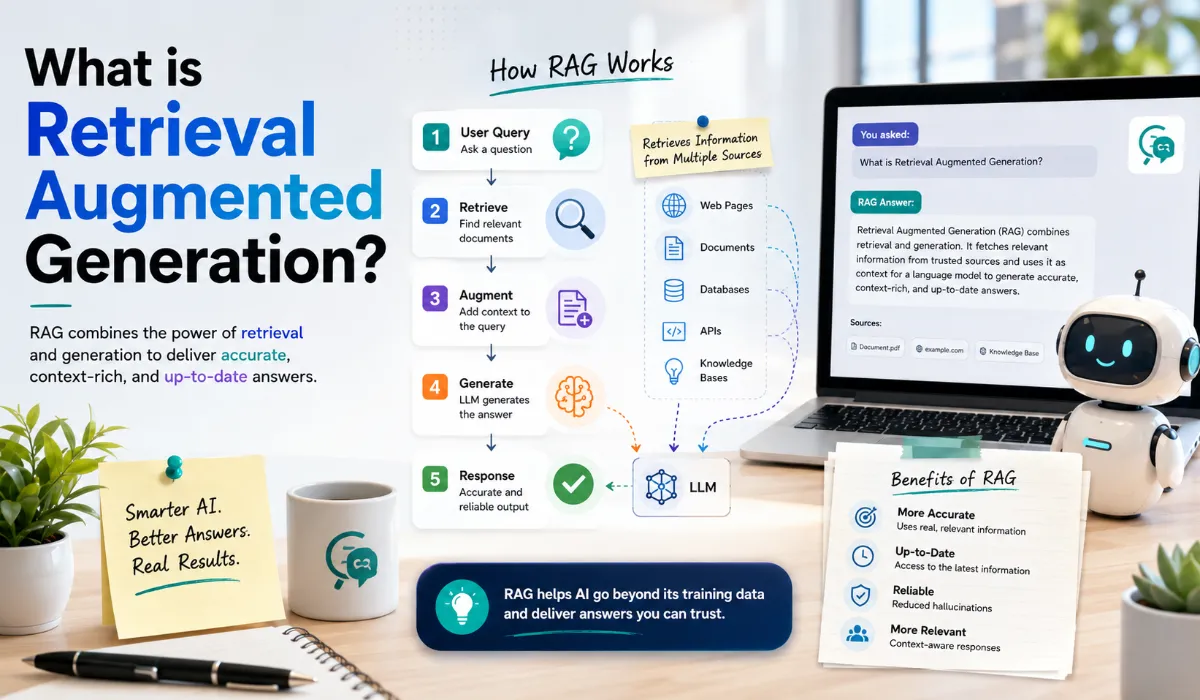
Artificial Intelligence is becoming smarter every day, but traditional AI models still have one major challenge, they may provide outdated or incorrect information. This is where What is RAG (Retrieval Augmented Generation) becomes important.
RAG is a technology that helps AI systems find relevant information from external sources and use that information to generate more accurate answers. In simple words, RAG allows AI to search, understand, and respond using additional knowledge instead of depending only on its previous training data.
Today, RAG in AI is widely used to build smarter applications, especially when businesses want AI tools that can work with their own documents, databases, and private information.
What is RAG (Retrieval Augmented Generation)?
Retrieval Augmented Generation is an AI approach that combines information retrieval with text generation. It allows an AI model to first search for relevant information and then use that information to create a response.
For example, imagine a company has thousands of product documents, customer guides, and internal reports. A normal AI model may not know this private information. But with RAG, the AI can search those documents, find the right details, and answer user questions accurately.
This makes AI systems more useful because they can provide answers based on real-time or company-specific information.
How RAG Works?
Understanding How RAG works is simple. The process usually includes four main steps:
1. User Asks a Question
The process starts when a user enters a question into an AI system. For example, a customer may ask an AI chatbot, “What is the refund policy for my order?”
2. AI Searches Relevant Information
Instead of immediately creating an answer, the RAG system searches a connected database, document library, or knowledge source to find useful information.
This step is called AI knowledge retrieval because the system retrieves the most relevant information related to the question.
3. Retrieved Information Is Shared With AI Model
The collected information is then provided to the AI model. Modern AI systems often use Large Language Models (LLMs) to understand the information and create human-like responses.
4. AI Generates the Final Answer
The AI combines the retrieved information with its language abilities and generates a clear, accurate response for the user.
This complete process is known as RAG architecture, where retrieval and generation work together to improve AI performance.
Why is RAG Important in AI?
Many AI models are trained on large amounts of data, but they may not always have access to the latest information or specific business knowledge. RAG solves this problem by connecting AI with external information sources.
Some key reasons why RAG is important include:
- It helps reduce incorrect AI responses.
- It allows AI to use updated information.
- It improves the accuracy of business AI tools.
- It helps companies use their own data securely.
- It makes AI responses more relevant and personalized.
For businesses, RAG is becoming a powerful part of Enterprise AI solutions because it allows employees and customers to interact with company knowledge easily.
RAG Applications in Real Life
There are many practical RAG applications across different industries:
Customer Support
Companies use RAG-powered AI chatbot systems to answer customer questions using product details, policies, and support documents.
Healthcare Information Systems
Healthcare organizations can use RAG to help professionals quickly find information from medical documents and research databases.
Business Knowledge Assistants
Companies can create internal AI assistants that help employees find information from company files, guidelines, and reports.
Document Search Systems
RAG improves document search by allowing users to ask questions in natural language instead of searching with specific keywords.
RAG vs Traditional AI Models
The difference between RAG vs traditional AI models is mainly about information access.
Traditional AI models depend mostly on the data they were trained on. If they do not have updated information, they may provide outdated answers.
RAG-based systems can access external databases and documents while generating responses. This allows them to provide more accurate and current information.
Benefits of RAG
The major Benefits of RAG include:
- Better accuracy in AI responses.
- Improved understanding of user questions.
- Access to updated information.
- Reduced chances of AI hallucinations.
- Better support for business-specific applications.
RAG also helps organizations make Generative AI more practical by connecting AI models with real-world knowledge.
Final Words
RAG has changed how modern AI systems work by allowing them to search and use external information before generating answers. Instead of relying only on existing training data, RAG helps AI provide more accurate, updated, and useful responses.
Understanding What is RAG (Retrieval Augmented Generation) is important because it represents the future of smarter AI applications. From customer support to business automation, RAG is helping organizations build AI systems that are more reliable, intelligent, and useful.
People also ask (FAQs)
1. How to explain RAG in an interview?
Answer:
RAG (Retrieval-Augmented Generation) is a technique that improves an LLM by connecting it with external knowledge sources. Instead of relying only on the model’s training data, RAG first retrieves relevant information from documents, databases, or company knowledge bases and then uses that information to generate a more accurate answer.
Simple example:
A company chatbot using RAG can answer questions from internal policies, product manuals, or customer documents without retraining the AI model.
2. What is RAG used for?
Answer:
RAG is mainly used when an AI system needs access to specific, updated, or private information.
Common use cases:
- Enterprise knowledge assistants
- Customer support chatbots
- Document search and Q&A
- Legal and medical research assistants
- Internal company AI assistants
- Product recommendation systems
- Financial report analysis
3. Is ChatGPT a RAG model?
Answer:
No, ChatGPT itself is not purely a RAG model.
ChatGPT is primarily an LLM-based application. However, ChatGPT and similar AI systems can use RAG-like techniques when they access external sources such as uploaded files, connected tools, or databases.
So:
- LLM = the intelligence engine
- RAG = a method to provide additional knowledge to the LLM
4. What is RAG vs MCP?
Answer:
RAG and MCP solve different problems.
RAG:
Helps an AI model find and use information.
Example: “Search company documents and answer my question.”
MCP (Model Context Protocol):
Helps an AI model connect with external tools and systems.
Example: “Check my CRM, update a customer record, and send an email.”
Simple difference:
RAG gives AI knowledge.
MCP gives AI capabilities.
5. What is LLM and RAG?
Answer:
LLM (Large Language Model):
An AI model trained on massive amounts of text to understand and generate human-like language.
Examples:
- GPT
- Claude
- Gemini
- Llama
RAG:
A system that enhances an LLM by providing additional information from external sources.
Think:
LLM = Brain
RAG = Library connected to the brain
6. How to implement RAG in LLM?
Answer:
A basic RAG implementation has these steps:
- Collect documents/data
- Convert documents into smaller chunks
- Create embeddings (convert text into vectors)
- Store embeddings in a vector database
- User asks a question
- Retrieve relevant information
- Send retrieved information + question to LLM
- Generate final answer
Typical stack:
- LLM: GPT, Claude, Gemini, Llama
- Embedding model: OpenAI embeddings, BGE, E5
- Vector database: Pinecone, Weaviate, Chroma, FAISS
7. Why is RAG better than LLM?
Answer:
RAG is not always better than an LLM. It improves LLM performance for specific situations.
Advantages of RAG:
✅ Uses latest information
✅ Works with private company data
✅ Reduces hallucination
✅ Avoids expensive model retraining
✅ Provides source-based answers
Example:
A normal LLM may not know your company’s internal HR policy.
A RAG system can answer because it retrieves your HR documents.
8. Can I create my own RAG?
Answer:
Yes, anyone can create a RAG system.
You need:
- Data/documents
- Embedding model
- Vector database
- LLM API or open-source model
- Retrieval pipeline
You can build:
- Personal knowledge assistant
- Website chatbot
- Company internal AI assistant
- Research assistant
Tools like LangChain, LlamaIndex, and Haystack make development easier.
9. Which LLM should I use for RAG?
Answer:
It depends on your requirement.
For high accuracy:
- GPT models
- Claude models
- Gemini models
For cost efficiency:
- Llama models
- Mistral models
For private/on-premise systems:
- Llama
- Mistral
- Qwen
The best choice depends on:
- Data privacy
- Cost
- Response quality
- Speed requirements
10. Is OKF better than RAG?
Answer:
Assuming you mean OKF (Open Knowledge Framework), it is not a direct replacement for RAG.
RAG is a technique for improving LLM responses using external information.
Different approaches solve different problems:
- RAG: Retrieve relevant information before generating answers.
- Knowledge frameworks: Organize and manage knowledge structures.
In most enterprise AI applications today, RAG is more commonly used because it is practical, scalable, and easier to implement.
11. What is RAG in business?
Answer:
In business, RAG means connecting AI models with company-specific knowledge so employees and customers can get accurate answers.
Examples:
Customer Support:
AI answers questions from product documentation.
HR:
Employees ask company policy questions.
Sales:
AI provides product details and competitor information.
Legal:
AI searches contracts and regulations.
Marketing:
AI analyzes brand guidelines and campaign data.
Business benefit:
RAG turns a general AI assistant into a company-specific AI expert.