AI Smart Summary
| Key Point | Direct Answer |
|---|---|
| Artificial Intelligence (AI) | AI is the broad field of computer systems designed to perform tasks that normally require aspects of human intelligence. |
| Superintelligence (ASI) | ASI is a hypothetical form of AI that would broadly outperform humans across intellectual and cognitive tasks. |
| Does AI exist today? | Yes. AI is already used in generative tools, recommendation systems, computer vision, healthcare, finance, and many other fields. |
| Does ASI exist today? | No confirmed example exists. Artificial superintelligence remains a theoretical concept. |
| AI vs ASI | Current AI may exceed humans at specific tasks, while ASI would theoretically surpass human capabilities across a much broader range of tasks. |
| Where does AGI fit? | AGI generally refers to hypothetical AI with broad, human-comparable capabilities. In common frameworks, it sits conceptually between today’s AI and ASI. |
| Bottom Line | AI is today’s real technology; ASI is a possible future level of AI that would broadly exceed human intelligence. |
Overview
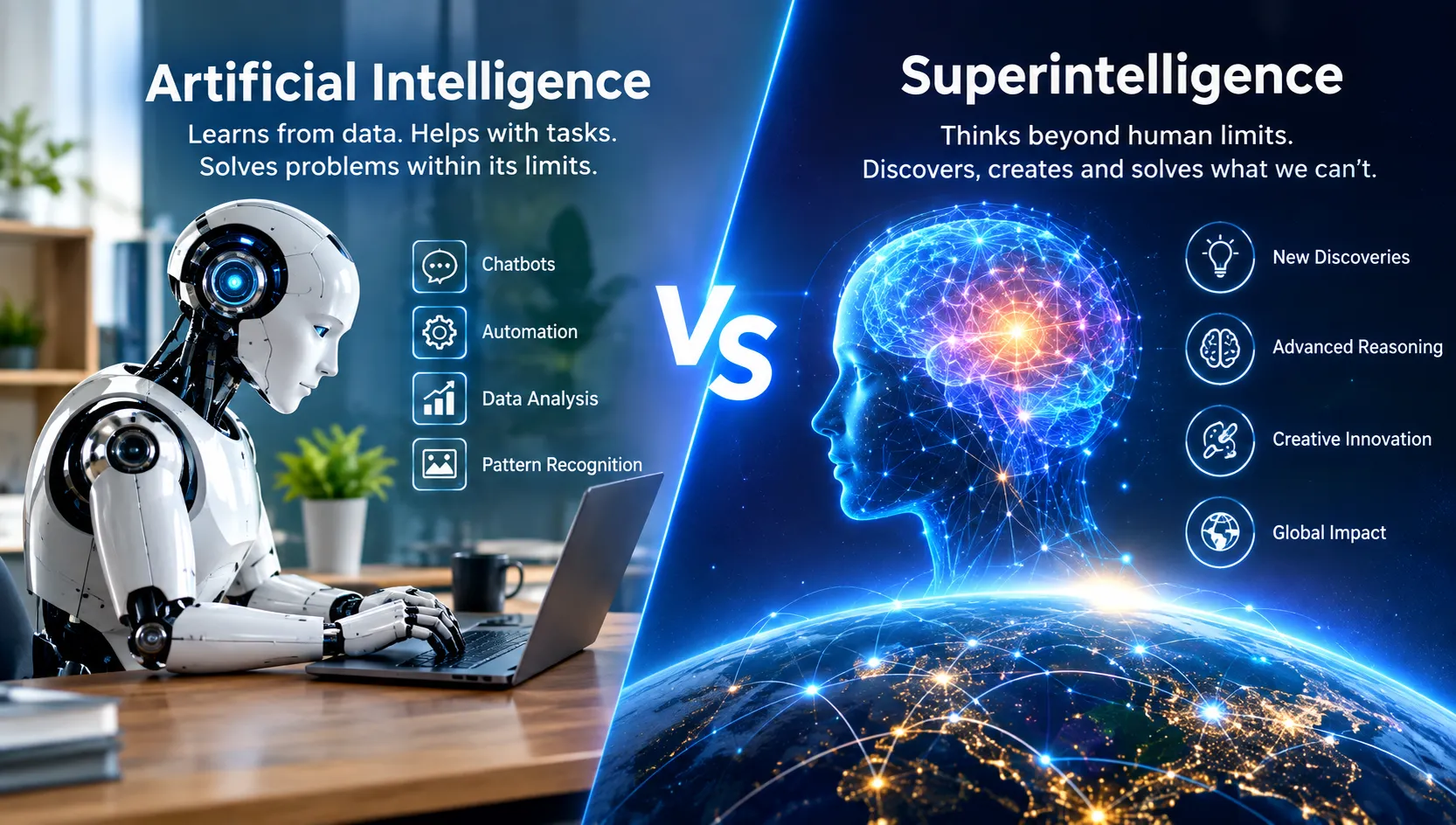
Artificial intelligence is already part of everyday life, from recommendation systems and navigation apps to generative AI assistants. Superintelligence is different. It describes a hypothetical level of artificial intelligence that would outperform humans across a broad range of intellectual tasks.
That makes super intelligence vs artificial intelligence more than a comparison between two technologies. Artificial intelligence is the broad field that exists today, while artificial superintelligence, or ASI, represents a possible future level of machine capability.
Here is the simplest comparison.
| Feature | Artificial Intelligence (AI) | Artificial Superintelligence (ASI) |
|---|---|---|
| Basic meaning | Technology designed to perform tasks associated with intelligence | Hypothetical AI that would broadly exceed human intellectual abilities |
| Exists today? | Yes | No confirmed ASI exists |
| Current applications | Search, recommendations, language tools, vision, automation and more | No established real-world applications |
| Intelligence level | Varies widely by system | Theoretically beyond human intelligence |
| Scope | Often specialized | Expected to be broad and highly capable |
| Examples | AI assistants, recommendation systems, image recognition | Currently hypothetical |
| Development stage | Actively researched and deployed | Theoretical/future concept |
| Human comparison | Can outperform people at particular tasks | Would exceed humans across many cognitive domains |
What Is Artificial Intelligence?
Artificial intelligence (AI) is a broad area of computing concerned with building systems capable of performing tasks that normally involve aspects of human intelligence.
These tasks can include understanding language, recognizing patterns, generating content, making predictions, solving problems and interpreting images.
AI does not need to think exactly like a human to be useful.
A chess program, for example, can perform exceptionally well at chess without possessing the broad reasoning abilities of a person. Similarly, an image-recognition system might identify objects extremely accurately while being unable to perform unrelated tasks.
This distinction matters because the phrase artificial intelligence covers systems with very different levels and types of capability.
What Are Some Examples of AI Today?
Modern AI is already used across consumer products, businesses, healthcare, finance, transportation and scientific research.
| AI Application | What It Can Do |
|---|---|
| Generative AI | Produces text, images, audio, code and other content |
| Recommendation systems | Suggest products, videos, music or other content |
| Computer vision | Identifies and analyzes visual information |
| Speech recognition | Converts spoken language into usable digital information |
| Fraud detection | Finds unusual patterns in transactions |
| Translation | Translates text or speech between languages |
| Predictive systems | Uses data to estimate possible outcomes |
These systems can be powerful, but being highly capable at certain tasks does not automatically make them superintelligent.
What Is Artificial Superintelligence?
Artificial superintelligence (ASI) is generally used to describe a hypothetical artificial intelligence whose cognitive capabilities would broadly surpass those of humans.
The key word is hypothetical.
There is currently no broadly accepted example of artificial superintelligence. ASI is mainly discussed in AI research, philosophy, technology forecasting and AI-safety debates.
A theoretical superintelligent system could potentially outperform humans in areas such as scientific reasoning, strategic planning, learning, problem-solving and other intellectual activities.
Exactly what such a system would look like—or whether it will ever be developed—remains uncertain.
What Is the Main Difference Between AI and Superintelligence?
The biggest difference is scope and capability.
Artificial intelligence is the overall field. It includes everything from relatively simple specialized systems to advanced generative models.
Superintelligence describes a proposed level of capability within the broader discussion of AI.
Think of the relationship this way:
Artificial Intelligence → broad category
Artificial General Intelligence → proposed general-purpose capability
Artificial Superintelligence → hypothetical capability beyond human intelligence
Therefore, AI and ASI should not be treated as completely separate technologies.
ASI is better understood as a possible form or stage of artificial intelligence.
AI vs AGI vs ASI: What’s the Difference?
The terms AI, AGI and ASI are sometimes used interchangeably online, but they do not mean the same thing.
| Term | Full Name | General Meaning | Current Status |
|---|---|---|---|
| AI | Artificial Intelligence | Broad field of machines performing intelligent tasks | Exists today |
| Narrow AI | Narrow Artificial Intelligence | AI optimized for particular tasks or domains | Widely used |
| AGI | Artificial General Intelligence | Proposed AI with broad, general capabilities comparable to humans under common definitions | No broadly accepted demonstration |
| ASI | Artificial Superintelligence | Hypothetical AI broadly exceeding human intellectual capability | Hypothetical |
The exact definition of artificial general intelligence (AGI) varies among researchers, so there is no single universally accepted test for determining when AGI has been achieved.
ASI goes further. Instead of merely reaching broad human-level capability, it would surpass it.
Is Generative AI a Form of Superintelligence?
No. Generative AI and artificial superintelligence are different concepts.
Generative AI describes systems designed to generate content, such as text, images, software code, music or video.
Modern generative models can perform an impressive variety of tasks. However, impressive performance does not by itself demonstrate the broad superiority over human cognition implied by artificial superintelligence.
This is an important distinction because rapid improvements in AI sometimes cause advanced AI and ASI to be discussed as though they are the same thing.
They are not.
Does Superintelligence Exist Today?
There is currently no broadly accepted artificial superintelligence system.
AI systems can already outperform humans in specific areas. Computers have demonstrated exceptional performance in games, pattern recognition, calculations and other specialized tasks.
But outperforming humans at individual tasks is different from possessing intelligence that broadly exceeds human cognitive abilities.
That distinction separates today’s powerful AI systems from the theoretical concept of ASI.
Could AI Eventually Become Superintelligent?
It is possible to discuss superintelligence as a future scenario, but its development cannot be treated as a certainty.
Researchers disagree about how advanced AI will develop, what architecture would be required for more general intelligence, and whether concepts such as AGI or ASI will ultimately be achieved.
Several questions remain unresolved:
| Question | Why It Matters |
|---|---|
| Can AI develop sufficiently broad reasoning abilities? | Specialized performance is different from general intelligence |
| How should intelligence be measured? | Human intelligence itself is multidimensional |
| Would AGI necessarily lead to ASI? | One does not automatically establish the other |
| Can increasingly capable systems remain reliable and controllable? | Safety becomes more important as capabilities increase |
| When could ASI exist? | There is no established timeline |
Predictions about exactly when superintelligence will arrive should therefore be treated as predictions rather than established facts.
What Could Be the Benefits of Artificial Superintelligence?
If ASI ever became possible and could be developed and deployed safely, researchers and commentators have proposed numerous potential applications.
A highly capable system might assist with difficult scientific research, medicine, engineering, mathematics, climate modeling and complex optimization.
For example, it could theoretically help researchers analyze enormous datasets or explore solutions much faster than conventional approaches.
These are potential scenarios rather than existing ASI applications.
That distinction is essential when discussing the benefits of superintelligence.
What Are the Potential Risks of Superintelligent AI?
The capabilities that could make advanced AI useful could also create significant challenges.
Researchers studying advanced AI frequently consider issues involving system reliability, alignment with intended goals, misuse, cybersecurity, governance and human oversight.
A central question is straightforward: how can humans ensure that increasingly capable AI systems behave as intended?
The importance of this question increases alongside the capabilities and autonomy of a system.
Discussions about ASI therefore aren’t only about building more intelligent machines. They also involve understanding how extremely capable systems could be tested, governed and controlled.
Frequently Asked Questions
Is artificial intelligence the same as superintelligence?
No. Artificial intelligence is the broad field of creating systems that perform intelligent tasks. Superintelligence is a hypothetical form of AI that would broadly surpass human intellectual capabilities.
Is ChatGPT artificial superintelligence?
No. Generative AI systems can perform many sophisticated tasks, but that does not establish the broad superhuman intelligence associated with the concept of ASI.
What is the difference between AGI and ASI?
AGI generally refers to hypothetical AI with broad, general-purpose capabilities comparable to humans under common definitions. ASI would go further by broadly exceeding human cognitive capabilities.
What is an example of artificial superintelligence?
There is currently no confirmed real-world example of artificial superintelligence. Examples of ASI are therefore hypothetical rather than existing technologies.
Is superintelligence possible?
It remains an open question. Superintelligence is studied and debated as a possible future development, but whether, how or when ASI could be achieved is uncertain.
What comes after AGI?
In commonly used AI capability frameworks, ASI (Artificial Superintelligence) is described as a stage beyond AGI. This is a conceptual framework, however, rather than an established development roadmap.